You’re standing in front of two swimsuits — both tagged “recycled nylon,” both priced somewhere north of $150, both made by brands that use the word sustainable without flinching. One hang-tag says REPREVE. The other says ECONYL. If you’ve been circling the premium eco-swim space for a season or two, you already know these aren’t just marketing words — they’re the names of actual fiber systems with documented supply chains. But knowing the names and knowing what to do with them are different things. This article is the translation layer: we’ll explain exactly what each material is in plain English, stack them against each other on the criteria that matter for swimwear specifically, and give you a clear decision rule by the end so your next purchase isn’t a guess.
What REPREVE and ECONYL Actually Are — Starting from Zero
Both are recycled synthetic yarn systems, meaning they’re made from waste material rather than virgin petroleum. That’s the shared foundation. The differences are in what waste they start with, how they process it, and what certifications travel with the finished yarn.
REPREVE is a brand owned by Unifi, Inc., a U.S.-based fiber manufacturer. Their yarn is made primarily from post-consumer plastic bottles — the kind you’d toss into a recycling bin. Those bottles are cleaned, chipped into flake, melted, and extruded into fiber. REPREVE produces both recycled polyester and recycled nylon, though recycled polyester (rPET) is their dominant output. Every REPREVE product carries a tracer technology called U TRUST verification, which allows brands — and theoretically consumers — to confirm the recycled content through third-party testing. Textile Exchange, in its Preferred Fiber & Materials Market Report 2024, lists REPREVE among the most widely adopted recycled-fiber systems by volume globally.
ECONYL is a brand and regeneration system owned by Aquafil, an Italian nylon producer. Its input stream is different and more specific: ECONYL is made from pre-consumer and post-consumer nylon waste — fishing nets, fabric scraps, carpet flooring, and industrial waste. Crucially, Aquafil’s documented process includes depolymerization, meaning the nylon is chemically broken back down to its monomer state (caprolactam) and then re-polymerized into new nylon 6 yarn. This is a closed-loop chemical recycling process, not just mechanical melting. The output is regenerated nylon 6 that Aquafil, per the ECONYL Regeneration System technical documentation published by Aquafil Group, describes as chemically equivalent to virgin nylon 6 in performance terms.
The practical takeaway before we go deeper: REPREVE = mostly recycled bottles → recycled polyester or nylon via mechanical process. ECONYL = discarded fishing nets and nylon waste → regenerated nylon 6 via chemical process. Both are genuinely recycled. They are not interchangeable.
The Certification Stack: What Each Label Actually Guarantees
Here’s where most buying guides lose the thread. “Recycled” is not a regulated term on its own. The fiber brand name tells you what the yarn is made from. Certifications layered on top tell you how safely it was processed and whether the recycled content claim is independently verified. These are separate questions.
REPREVE’s Certification Landscape
REPREVE fiber carries Global Recycled Standard (GRS) certification, administered by Textile Exchange — the primary third-party audit confirming that recycled content claims are accurate and traceable. GRS covers chain of custody from waste collector through yarn producer. Unifi also holds OEKO-TEX STANDARD 100 certification for select REPREVE yarns. Per the OEKO-TEX STANDARD 100 certification criteria documentation published by OEKO-TEX Association, that certification requires testing against more than 100 harmful substances including heavy metals, pesticides, and formaldehyde — important for a fabric that sits against your skin in chlorinated or salt water for hours at a time.
What REPREVE does not automatically provide: bluesign certification. The bluesign System Standard, as documented by bluesign technologies ag, covers the fabric production facility — dye chemistry, water use, energy input, and worker safety at the mill level — not just the fiber. A finished swimsuit made from REPREVE yarn may or may not be bluesign-approved depending on where and how it was knitted and dyed. You have to read the brand’s supply-chain documentation to know.
ECONYL’s Certification Landscape
ECONYL fiber carries GRS certification as well — Textile Exchange administers both. Aquafil’s production facilities have also achieved OEKO-TEX STANDARD 100 certification for ECONYL yarn, per publicly available Aquafil Group documentation. So at the fiber level, REPREVE and ECONYL are comparably certified: both GRS, both capable of OEKO-TEX.
The material difference comes at the process level. Because ECONYL uses chemical depolymerization, Aquafil positions it as theoretically infinitely recyclable — the nylon can, again in theory, be broken back down and regenerated multiple times. Per the ECONYL Regeneration System documentation published by Aquafil Group, the process recovers nylon from waste streams that mechanical recycling cannot handle: fishing nets are too contaminated with salt and marine debris for simple melt-and-extrude. That is a genuine differentiator, not marketing language.
The bluesign Layer — Brand Responsibility, Not Fiber Responsibility
Neither fiber brand controls what happens at the fabric mill. The bluesign System Standard evaluates facilities on chemistry management, resource productivity, consumer safety, and water and air emissions — none of which are within the fiber supplier’s scope. A brand that sources ECONYL yarn and also requires bluesign-approved facilities for dyeing and finishing is making a materially stronger commitment than one that stops at the fiber level. Good On You’s brand rating methodology — published by Good On You, the independent fashion ethics platform — explicitly evaluates mill-level certifications as a separate layer from fiber sourcing when assigning overall brand scores. The point: the certification stack you’re evaluating is brand + fiber + mill, not fiber alone.
Swimwear-Specific Performance: Where the Difference Shows Up
Certifications tell you about ethics and safety. Performance tells you about your $200 investment surviving a summer. The two materials diverge meaningfully on several swimwear-specific axes, which is why they’ve each settled into different price tiers organically rather than by marketing strategy.
Premium Tier — Pool Performance and Chlorine Resistance
Chlorine resistance is the most important swimwear performance variable for regular swimmers, and here the materials diverge in a way that matters at the premium tier. Nylon — which ECONYL exclusively produces — has superior chlorine resistance compared to polyester. Business of Fashion’s Sustainable Materials Benchmarking coverage from 2024 notes that nylon remains the preferred base fiber for performance and luxury swimwear precisely because of its stretch-recovery and chemical resilience characteristics. REPREVE polyester (rPET), while excellent for UV resistance and quick-dry performance, is more vulnerable to chlorine degradation over time. If a suit is labeled REPREVE, check whether it uses Unifi’s nylon variant or their polyester variant — the hang-tag or brand website should specify, and the difference in pool performance is real.
At the premium tier ($150–$300+), ECONYL-based suits are the stronger call for anyone swimming laps or spending significant time in chlorinated water. Brands such as Vitamin A Swim — whose sourcing practices have been covered by Ecocult, the sustainable fashion publication — build most of their line in ECONYL specifically because of these performance credentials. Onia similarly uses ECONYL across its core swim fabrications at this tier.
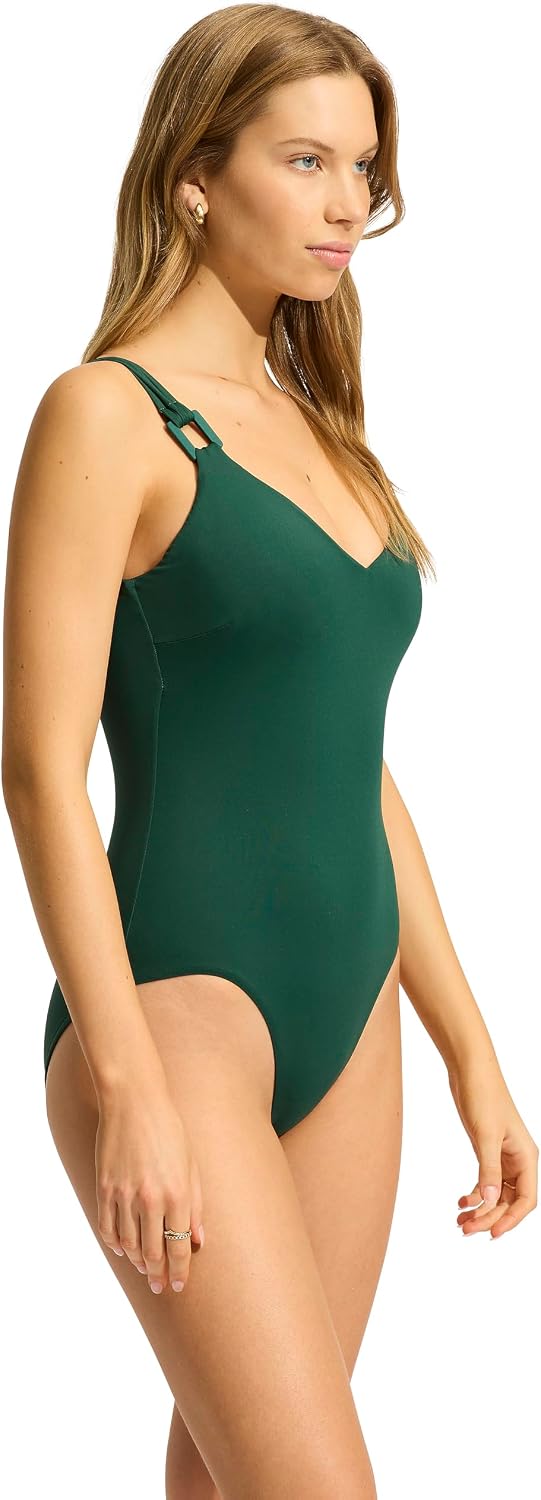
Seafolly
$198.00
In stock on Amazon
Check price on AmazonMid-Tier Performance — Where REPREVE Earns Its Place
For beach, sun, and occasional ocean swimming — not competitive or regular pool use — REPREVE polyester performs well and typically costs the brand less to source, savings that sometimes pass to the consumer. At the $70–$130 mid-tier, a REPREVE plus bluesign-mill combination is a genuinely responsible choice, not a compromise.
Stretch and recovery in swimwear is largely a function of knit construction and elastane blend, but nylon 6 — ECONYL’s output — does knit with more inherent recovery than polyester as a base fiber. At the mid-tier, that gap is partially closed by smart knit engineering, which is why strong mid-tier suits in REPREVE fabrics still perform acceptably for casual beach use. Girlfriend Collective’s use of REPREVE fiber in combination with bluesign-approved mill processes has been cited by Good On You, in its brand rating methodology documentation, as an example of credible mid-tier supply-chain transparency. Summersalt’s published sustainability materials reference recycled nylon and polyester inputs consistent with REPREVE’s supply chain.
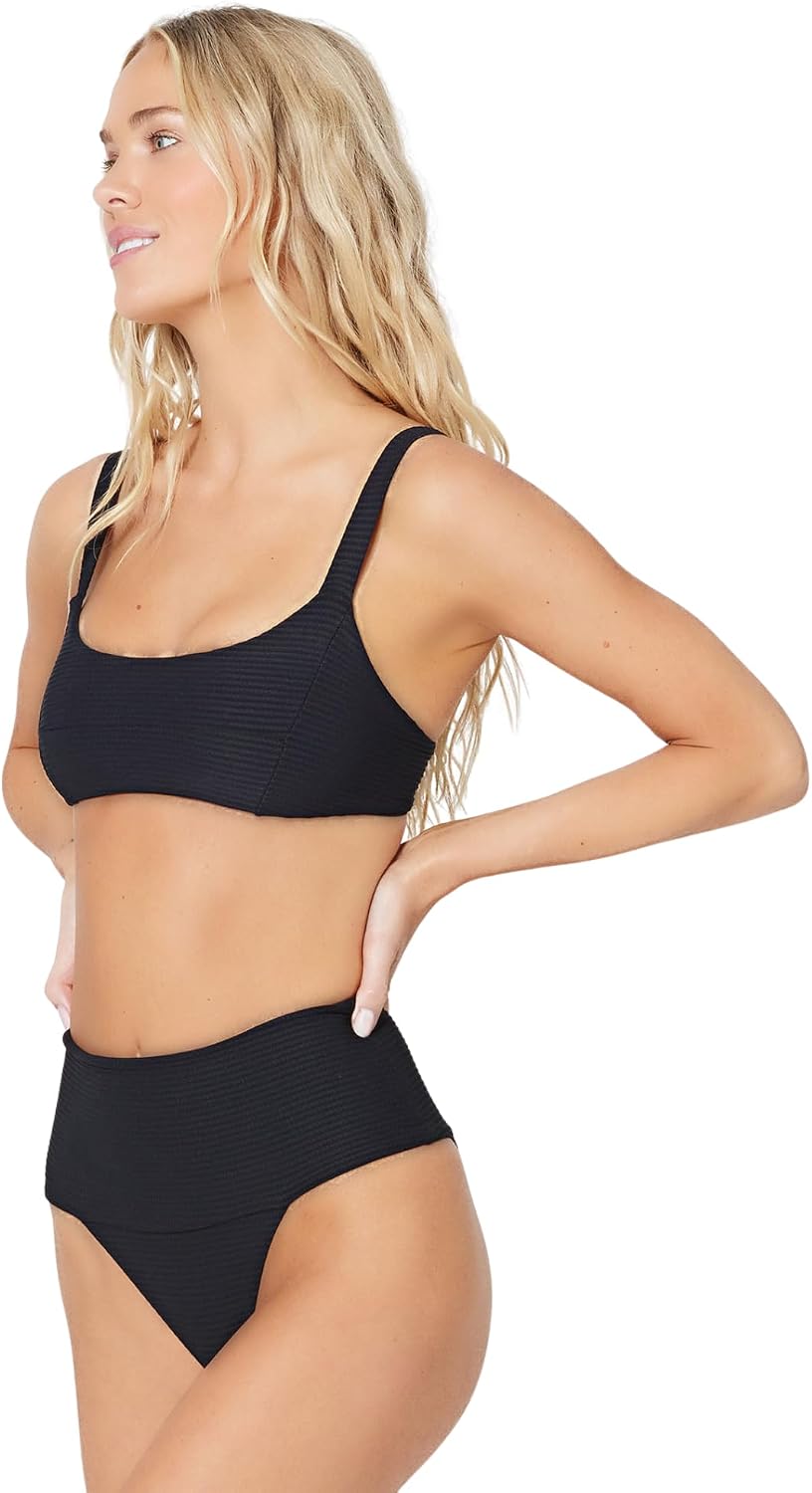
L*Space
$106.00
In stock on Amazon
Check price on AmazonBudget Tier — When “Recycled” Means Less
At the entry tier ($25–$60), “recycled” claims are least likely to be independently verified. GRS certification is rare at this price point, third-party audits are uncommon, and the fiber may or may not originate from a branded system like REPREVE or ECONYL. Textile Exchange, in its Preferred Fiber & Materials Market Report 2024, notes that GRS-certified recycled content still represents a minority of total “recycled” claims in mass-market apparel — a meaningful caution for the eco-conscious entry buyer.
If a brand at this tier claims recycled content, ask for their GRS certificate number. Per Textile Exchange’s GRS guidelines, certificate numbers are public and searchable. Any legitimate brand using GRS-certified fiber can point you to the documentation. Without it, “recycled” is a marketing claim, not a documented fact.
L*Space
$106.00
In stock on Amazon
Check price on AmazonHead-to-Head: REPREVE vs. ECONYL by the Numbers
| Attribute | REPREVE | ECONYL |
|---|---|---|
| Primary fiber output | Recycled polyester (rPET) + recycled nylon | Regenerated nylon 6 only |
| Recycling process | Mechanical (melt & extrude) | Chemical (depolymerize & re-form) |
| Core waste inputs | Post-consumer plastic bottles | Fishing nets, fabric scraps, carpet waste |
| Chlorine resistance | Moderate (polyester) / Good (nylon variant) | Excellent |
| Shared certifications | GRS + OEKO-TEX (select yarns) | GRS + OEKO-TEX |
| Theoretical recyclability | Single mechanical cycle | Closed-loop multiple cycles |
| Typical price tier | $70–$130 mid-tier | $150–$300+ premium tier |
L*Space
$106.00
In stock on Amazon
Check price on AmazonL*Space
$106.00
In stock on Amazon
Check price on AmazonSeafolly
$198.00
In stock on Amazon
Check price on AmazonHow to Read a Hang-Tag Like a Supply-Chain Analyst
The fiber name is the starting point, not the finish line. Here is the three-question check to run on any suit before purchasing:
1. Which fiber system, and which variant? REPREVE polyester and REPREVE nylon perform differently in chlorinated water. ECONYL is always nylon 6. The hang-tag or brand materials page should tell you which you’re buying — if it doesn’t, that’s an information gap worth flagging.
2. What mill-level certifications does the brand publish? Bluesign certification at the fabric-production facility is the strongest available indicator of responsible dye and finishing chemistry. OEKO-TEX STANDARD 100 on the finished garment (not just the fiber) is the second-strongest. Per OEKO-TEX Association’s STANDARD 100 criteria documentation, the finished-garment certificate covers all components — fabric, dyes, threads, closures — not just the base fiber. A brand displaying only “made with ECONYL” without any mill-level certification is telling you half the story.
3. Is there a GRS certificate number you can verify? Textile Exchange’s GRS framework requires a public certificate number for every link in the chain of custody. Brands with nothing to verify have nothing to show. The certificate search is available directly through Textile Exchange’s published GRS documentation and public database.
Business of Fashion’s sustainable materials coverage has noted a broader industry pattern worth understanding: as chemical recycling infrastructure scales, the cost premium for ECONYL-type regenerated nylon is expected to compress. For now, the tier split — REPREVE mid, ECONYL premium — reflects real production economics, not arbitrary brand positioning.
The Decision Rule: If X, Then Y
If you swim in pools regularly and your suit will see chlorine more than saltwater: prioritize ECONYL. The chemical recycling process produces a nylon 6 with documented performance equivalence to virgin nylon, and nylon’s chlorine resistance is structurally superior to polyester. At the $150-plus tier, this is the fiber you want.
If your use case is beach, sun, and occasional ocean swimming: REPREVE polyester performs well and costs less. At the $70–$130 tier, a REPREVE plus bluesign-mill combination from a brand with published supply-chain documentation is a genuinely responsible choice, not a lesser one.
If you’re evaluating a brand’s overall ethics rather than just the fiber: don’t stop at the fiber name. Ask whether the brand has bluesign-approved mills, whether they publish OEKO-TEX certificates (not just “we use OEKO-TEX certified materials”), and check their Good On You rating for independent supply-chain evaluation. The fiber brand is the first layer of the certification stack, not the whole stack.
If a brand uses neither REPREVE nor ECONYL but still claims “recycled nylon”: ask for their GRS certificate number. Without third-party chain-of-custody verification, the claim is unconfirmed.
The bottom line: ECONYL is the stronger choice for performance and circular-economy credentials at the premium tier; REPREVE is the honest, well-verified workhorse for the mid-tier buyer who needs a documented recycled claim without the premium price. Neither is greenwashing. Both are meaningfully better than virgin synthetic. The difference is in the specifics — and now you have the specifics.