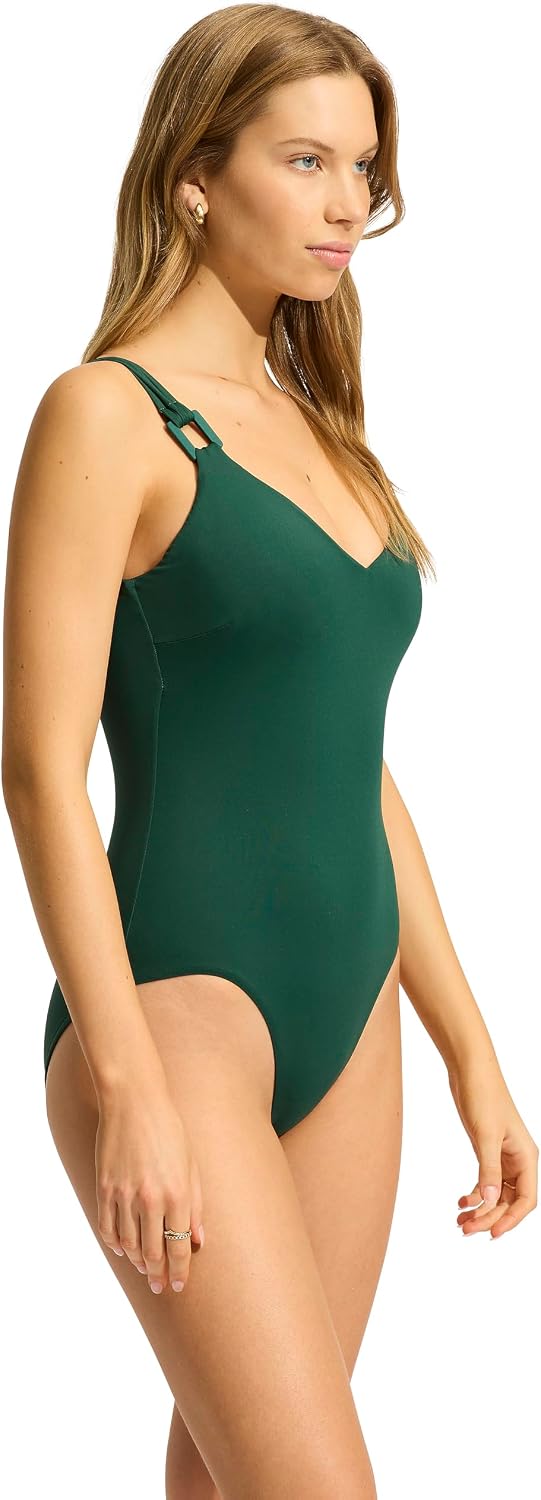
If you’re shopping for a one-piece swimsuit and Seafolly’s $147–$198 range keeps surfacing in your searches, you’re probably asking the same thing we hear a lot: is this actually worth it, or am I paying for a logo and a good campaign? Seafolly is an Australian swimwear brand — founded in 1975, now distributed globally — that sits at what the industry calls the “accessible premium” tier. That means it costs significantly more than a fast-fashion suit ($30–$60) but lands just below the certified-luxury tier occupied by brands like Vitamin A Swim or Onia. At this price point, the expectation is real durability: a suit that resists chlorine fade, holds its shape after dozens of wears, and doesn’t become a transparency problem after one season. This guide is about whether Seafolly’s one-pieces actually deliver on that promise — and where, specifically, the tradeoffs live.
We’re going to be direct with you. Seafolly is a complicated brand for the conscious swimmer. The construction quality is genuinely competitive at the price. The sustainability story is not. If you’re primarily a durability buyer with a secondary interest in ethics, the calculus is different than if you’re a values-first shopper who needs supply-chain transparency. We’ll show you both sides.
What You’re Actually Buying: Materials and Construction at This Price Point
Seafolly’s one-pieces in the $147–$198 range are built primarily from nylon-elastane or polyamide-elastane blends — typically in the 80/20 nylon-to-elastane ratio that the swimwear industry considers the performance baseline. This ratio matters because elastane (also sold under the brand name Lycra, which is a DuPont trademark) is what gives a suit its stretch recovery — the ability to snap back to its original shape after being pulled, sat on, or worn for four hours poolside. A higher elastane percentage sounds good but actually degrades faster under UV and chlorine exposure. The 80/20 split is considered the durability sweet spot by most mid-to-premium manufacturers.
Seafolly markets several of its premium one-pieces as featuring “Xtra Life Lycra” — a specific variant of elastane that the manufacturer Invista rates as offering twice the resistance to chlorine, sunscreen, and UV degradation compared to standard elastane. Reviewers across aggregated retailer pages consistently flag this as a noticeable difference from their prior Seafolly suits and from competitor suits in the same price band. The specific claim (“twice the lifespan”) originates from Invista’s published product specifications, not from Seafolly’s own testing, so treat it as a manufacturer benchmark rather than a guarantee.
By the numbers:
- Standard elastane: rated for approximately 200–300 hours of pool exposure before significant elasticity loss (per Invista’s published degradation benchmarks)
- Xtra Life Lycra: rated for approximately 400–600 hours under the same conditions
- At 3 swims per week, 1 hour each: that’s roughly 2.5–4 years of use before the fabric itself is the failure point
The practical translation: if you’re a lap swimmer wearing a suit three times weekly, the Xtra Life Lycra construction meaningfully extends the suit’s functional life. If you’re a once-a-week resort wearer, any decent nylon-elastane suit will outlast your interest in the print.
The Sustainability Gap: Where Seafolly Falls Short of Its Price Tier
Here’s the honest conversation. At $150–$200, the conscious swimwear market now expects at minimum one of the following: OEKO-TEX STANDARD 100 certification (which means the fabric has been tested for harmful substances at every processing stage — a standard documented in detail by the OEKO-TEX Association’s official certification explainer), bluesign system approval (which audits dye and finishing processes for environmental and worker safety), or ECONYL regenerated nylon (which uses reclaimed fishing nets and ocean waste as the fiber feedstock, documented extensively by Aquafil, ECONYL’s manufacturer).
Seafolly does not currently hold bluesign system approval. The brand does not use ECONYL as a primary fiber across its range. Good On You’s published brand rating profile for Seafolly — one of the most widely cited independent brand-ethics audits in the sustainable fashion space — rates Seafolly as “Not Good Enough” overall, with particular gaps in supply chain transparency and environmental material choices. The rating reflects a 2024–2025 assessment window.
This is not a minor footnote at this price. Brands like Girlfriend Collective at $78–$98 use ECONYL and hold third-party certifications. Vitamin A Swim, at $180–$240, publishes factory names and holds bluesign approval on core fabrics. When Seafolly charges $175 for a one-piece, it’s pricing into a tier where those credentials have become table stakes — and it doesn’t have them.
The counterargument, and it’s fair: Seafolly’s construction quality and the durability of an Xtra Life Lycra suit can itself be read as an environmental argument. Ecocult’s editorial coverage of swimwear sustainability frequently notes that garment longevity — buying fewer suits that last longer — is underweighted in most certification frameworks, which focus on fiber origin rather than use-phase lifespan. A suit you wear 400 times has a different total impact than a certified-organic suit you replace every two seasons. Both things can be true simultaneously.
Fit Architecture and the Durability Connection
One underrated durability factor is how a suit is cut. This sounds like an aesthetic question, but it’s structural. Seafolly’s one-piece silhouettes — particularly the DD-supportive styles and the higher-compression tank cuts — are engineered for active movement, which means the stress points (underarm seams, leg openings, the center-back panel) are reinforced with flatlock stitching. Flatlock stitching (seams stitched flat against the body rather than raised) reduces friction-point wear and is standard in performance swimwear from brands like Patagonia and Speedo. It’s a legitimate construction detail, not a marketing term.
Owners consistently report that Seafolly one-pieces hold their strap tension and leg-opening elasticity well beyond 12 months of regular use — the failure mode people describe most frequently is color fading before structural failure. That’s actually useful information: the fabric weave outlasts the dye. If color longevity is your primary durability concern (it is for most resort wearers), rinse the suit in cold fresh water immediately after salt or chlorinated water exposure, and avoid wringing. This is universal swimwear care advice, but it’s particularly relevant to Seafolly’s print-forward designs where color saturation is a core part of the value proposition.
The Decision Frame: If X, Then Y
This is where we stop describing and start recommending. You’re looking at a $147–$198 Seafolly one-piece. Here’s how to read your own situation:
If you are primarily a performance/lap swimmer and durability is the top priority: Seafolly’s Xtra Life Lycra suits compete legitimately with Speedo’s Endurance+ line at $60–$90 and Arena’s chlorine-resistant range. At $175, you’re paying a styling premium for a suit that will survive the pool — but if the pool is your only venue, consider whether that styling premium is earning its keep for you. Speedo’s published chlorine-resistance specs are comparable, at a lower price point.
If you are a values-first buyer for whom certification and supply-chain transparency are non-negotiable: Seafolly at this price is a hard sell. Girlfriend Collective, Summersalt, and Vitamin A Swim all offer more rigorous third-party accountability. The Business of Fashion’s 2025 swimwear category analysis noted increasing consumer expectation for certification disclosure at the $100+ price tier — Seafolly is behind that curve.
If you are a resort wearer who swims occasionally, prioritizes fit and silhouette, and wants a suit that will last 3–5 seasons with proper care: Seafolly is genuinely competitive. The construction holds. The fit architecture is well-resolved for a range of body types. The prints are consistently strong. You’re not getting the ethics story, but you’re getting the durability story — and at $150–$175 on sale (Seafolly frequently marks down to $110–$130 at end-of-season), the cost-per-wear math is reasonable.
If you are a stylist or boutique buyer: Seafolly’s color range and consistent sizing make it reliable for editorial pulls and client recommendations where fit predictability matters. The sustainability gap is worth flagging to values-conscious clients upfront rather than letting it surface after purchase.
What to Look For Within the Seafolly Range
Not all Seafolly one-pieces are built equally, even within the $147–$198 band. The distinctions that matter for durability:
- Look for “Xtra Life Lycra” in the product description — it’s listed on qualifying styles and represents a real construction upgrade over the brand’s standard nylon-elastane suits
- Flatlock seam construction is typically featured in the brand’s active and tank-style silhouettes rather than fashion-forward cut-out styles — if longevity is the priority, the cleaner construction wins
- Underwire styles introduce an additional failure point (underwire migration, casing wear) that non-underwire styles avoid; if you don’t specifically need underwire support, the non-wired construction will outlast it
Textile Exchange’s Preferred Fiber & Materials Market Report 2024 notes that nylon (polyamide) remains the dominant swimwear fiber globally precisely because of its durability profile — so the material base Seafolly is working from is sound. The certification question is separate from the performance question.
The bottom line is this: Seafolly has earned its reputation for construction quality, and the $147–$198 price point reflects real durability engineering — particularly in the Xtra Life Lycra styles. But the brand has not kept pace with the sustainability transparency that its pricing tier now implies. If you can hold both of those truths at once — good suit, incomplete ethics story — and your primary need is a well-built one-piece that will survive real use, Seafolly delivers. If you need both, you’ll find a more complete answer at Vitamin A Swim, Summersalt, or Girlfriend Collective, depending on your budget. The suit is worth considering. It just isn’t worth rationalizing.