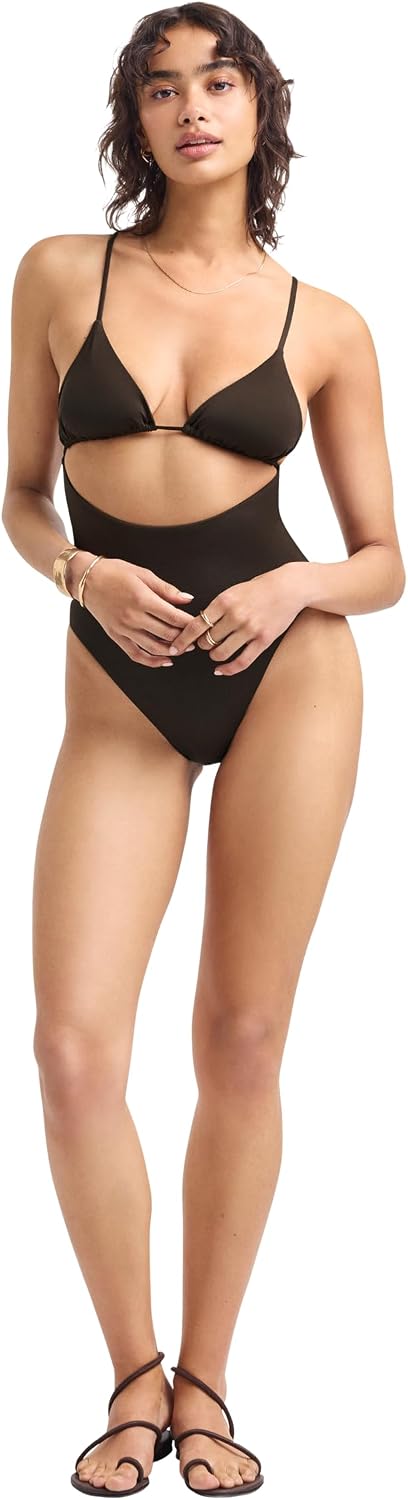
Let’s be honest about something: a $165 swimsuit is not an impulse buy. It’s a considered purchase — the kind where you open three browser tabs, read two reviews, and still feel a little uncertain standing at checkout. If you’re new to the world of sustainable swimwear, here’s the fast version of what’s going on: Vitamin A is a California-based swim brand that builds most of its lineup from a fabric called ECONYL (say it like “ee-co-nile”), which is regenerated nylon — meaning it’s spun from recovered ocean fishing nets, industrial plastic waste, and fabric scraps rather than drilled petroleum. That matters because conventional nylon is one of the more carbon-intensive synthetic fibers, and the swimwear industry uses a lot of it. ECONYL doesn’t eliminate the footprint, but it meaningfully reduces it. The question this article is designed to answer is a practical one: given that reduced footprint comes attached to a $150–$200 price tag, does the math actually work in your favor?
The short answer is: it depends on which suit you’re buying and how you swim. The longer answer is below — with the tradeoffs named explicitly.
What ECONYL Actually Is (and What It Isn’t)
ECONYL is a trademarked regenerated nylon yarn developed by Aquafil, an Italian fiber manufacturer. Unlike recycled polyester — which is commonly made from PET plastic bottles — ECONYL starts with nylon waste: discarded fishing nets from ocean cleanup operations, nylon carpet scraps, and pre-consumer fabric offcuts. That waste is depolymerized (broken back down to its chemical building blocks) and re-polymerized into a new yarn that Aquafil claims performs identically to virgin nylon 6.
The Textile Exchange’s Preferred Fiber & Materials Market Report 2024 confirms that regenerated nylon now accounts for a growing share of recycled fiber production globally, with Aquafil’s ECONYL program among the most documented closed-loop systems in commercial textile use.
Here’s the nuance that matters for swimwear specifically: ECONYL’s fiber quality is well-supported, but the finished fabric’s performance — how it holds color, resists chlorine, retains shape — depends almost entirely on what the mill does after the yarn arrives. Knit construction, dye process, and finishing treatments all vary by brand and supplier. Vitamin A sources from mills that hold bluesign certification (per Bluesign’s Approved Substances List and Mill Certification Standards), which addresses chemical safety in dyeing and finishing — a meaningful signal, but not a performance guarantee on its own.
What ECONYL is not: it is not inherently chlorine-proof, fade-proof, or pilling-resistant. Those properties are earned (or not) by the fabric construction and finishing. Owners of Vitamin A suits in long-run reviews consistently report strong colorfastness in salt and sun, with more varied feedback on chlorine pool wear — a distinction worth noting if you’re a lap swimmer versus a resort vacationer.
The Cost-Per-Wear Framework: How to Actually Run the Math
Cost-per-wear (CPW) is simple: divide the purchase price by the number of times you’ll realistically wear the item. A $165 one-piece worn 10 times costs $16.50 per wear. Worn 50 times, it’s $3.30. The question is which number is honest for your life.
By the numbers:
| Wear frequency | Total wears over 3 years | Cost per wear |
|---|---|---|
| Occasional (resort trips, 2–3x/season) | ~18 wears | $9.17 |
| Regular (weekly beach/pool, seasonal) | ~45 wears | $3.67 |
| High-use (lap swim + leisure) | ~90 wears | $1.83 |
The $165 entry point looks very different across those rows. For the occasional wearer — someone who packs a swimsuit twice a year for vacation — CPW lands around $9, which is reasonable but not compelling compared to a $90 mid-tier suit at $5 per wear. For the regular wearer, the math tilts clearly in Vitamin A’s favor, especially if the suit holds up through years three and four (which aggregated owner reviews suggest is plausible for their ECONYL/Lycra blends under normal care).
The critical variable is care. Owners who rinse with fresh water after each use and hand-wash in cold report dramatically better longevity than those who machine-wash on warm. Business of Fashion’s 2024 coverage of sustainable swimwear economics noted that premium-tier suits like Vitamin A’s can lose a significant portion of their functional lifespan from a single hot-water machine wash cycle — a data point that should absolutely be in your CPW assumptions.
Where Vitamin A Sits in the Certification Landscape
This is where the intermediate buyer needs to be precise, because “sustainable swimwear” covers a wide range of actual claims.
ECONYL certification is a supply-chain traceability mark — it tells you the yarn came from Aquafil’s verified regeneration program. It does not certify the finished garment’s chemical safety, the factory’s labor conditions, or the dye chemistry.
OEKO-TEX STANDARD 100 (per the OEKO-TEX certification overview) certifies that the finished textile has been tested for harmful substances at every production stage. Vitamin A does not consistently hold STANDARD 100 on its full line — a notable gap when compared to some competitors at similar price points.
Bluesign certification, which Vitamin A does reference for its mill sourcing, covers resource efficiency and chemical safety in the wet-processing phase. It’s a strong mill-level signal, but it’s a different layer of assurance than a finished-goods certification.
Good On You’s Vitamin A brand rating (published on their platform, updated through mid-2025) gives the brand a “Good” rating overall, citing the ECONYL material use and California-based design operation as positives, with lower scores on supply chain transparency into labor conditions further down the manufacturing chain — consistent with where most premium U.S. swim brands land.
Ecocult’s analysis of ECONYL versus virgin nylon frameworks notes that the carbon reduction benefit of ECONYL (roughly 57% lower global warming potential per Aquafil’s published lifecycle data) is real and material, but can be partially offset by long-haul shipping and chemical finishing — which is why the mill-level bluesign certification Vitamin A references is the correct next question to ask, not an afterthought.
The honest comparison matrix:
- ECONYL + bluesign mill sourcing (Vitamin A’s position): Strong material story, process-level chemical accountability, gap in finished-goods certification and full labor transparency.
- GOTS-certified organic cotton suits (some competitors): Strong labor and chemical story, weaker performance profile for active saltwater/chlorine use.
- OEKO-TEX STANDARD 100 + recycled nylon (Girlfriend Collective, some others): Strong finished-goods chemical assurance, often mid-tier price point, less rigorous fiber-origin documentation than ECONYL’s closed-loop system.
There is no swimsuit at any price point that aces every column. Vitamin A’s ECONYL suits are a strong answer to the material origin and performance durability questions. They are a weaker answer if your primary concern is end-to-end factory labor documentation.
Who Should Buy — and Who Shouldn’t
The decision frame here is straightforward if you name the variables honestly.
Buy if:
- You wear a swimsuit 15+ times per season (resort, beach, pool) and need it to hold shape and color across multiple years.
- Your primary use is salt water and sun, not lap-pool chlorine. Owner reviews consistently favor Vitamin A for the former.
- The environmental story matters to you as part of the value, not just as a tiebreaker — you’re paying a partial premium for the ECONYL sourcing, and that premium should feel like something you’re choosing, not something you’re tolerating.
- You’re building a capsule wardrobe for travel and want one suit that does heavy rotation without looking exhausted by week two.
Don’t buy if:
- You swim laps in chlorinated pools three or more times a week. Reviewers at this use intensity consistently report faster elasticity degradation in ECONYL/Lycra blends than in purpose-built competitive suits with higher chlorine-resistant fiber ratios.
- You want a finished-goods certification (OEKO-TEX STANDARD 100 or GOTS) as your primary trust signal. Vitamin A’s certifications don’t cover the finished garment at that level.
- Your honest wear count is under 15 total wears over the suit’s life. At that number, a $90 mid-tier option from a brand like Summersalt — which holds real certifications and performs reliably — likely wins on CPW math.
- You’re expecting the suit to last beyond year four without visible wear. Even optimistic owner reports cluster around three to four seasons of quality before fade or fit relaxation becomes notable.
The if/then summary:
- If you’re a regular ocean and resort swimmer building a true wardrobe investment, then the Vitamin A ECONYL one-piece earns its $165 across the CPW horizon.
- If you’re a chlorine-pool swimmer or a light-use occasional buyer, then the math and performance profile both push you toward a mid-tier certified alternative.
- If supply chain labor transparency is your primary filter, then no suit at this tier fully satisfies — and you should hold that standard consciously rather than letting marketing close the gap.
One Last Thing Before You Click
The most common mistake we see intermediate eco-swim buyers make is treating the ECONYL label as a full-story certification when it’s actually a yarn-origin mark. It’s meaningful — genuinely — but it answers one question in a five-question checklist. The five questions are: Where did the fiber come from? How was it processed? Who made it and under what conditions? Does the finished textile meet chemical safety standards? And will it last long enough to justify the price?
Vitamin A answers questions one, two, and five reasonably well. Questions three and four remain partially open — which is where you, as the buyer, have to decide whether “reasonably good” is good enough for what you’re willing to spend.
For a lot of conscious shoppers who prioritize durability and material origin and swim in the ocean a lot? It is. That’s not a hedge — it’s a clear editorial position. The suit is worth it for the right buyer. The work is figuring out, honestly, whether that buyer is you.